
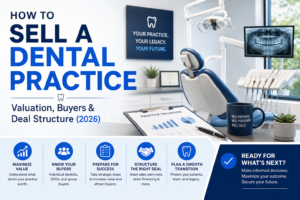
Deciding to sell a dental practice is one of the most significant financial decisions a dentist will ever make. Whether you are approaching retirement, relocating, or pursuing a new opportunity, the sale process for a dental practice has unique characteristics that differ from selling other types of businesses. Understanding these differences — from how practices are valued to who is buying them — is essential to achieving the outcome your years of work deserve.
This guide covers everything you need to know about selling a dental practice, including current market dynamics, valuation methods, buyer types, preparation steps, and deal structures.
How Dental Practices Are Valued
Dental practice valuations consider both the business earnings and the specific assets and characteristics unique to dentistry. The most common approach uses a multiple of earnings (SDE or EBITDA), but several dentistry-specific factors influence the multiple. For a broader understanding of business valuation, see our business valuation guide.
Typical Dental Practice Valuation Multiples
Solo dental practices typically sell for 60-80% of annual collections or 1.5x to 3.0x SDE, depending on profitability, location, patient base, and practice characteristics. Group practices and multi-location operations command higher multiples, often 4x to 7x EBITDA, especially when acquired by dental service organizations (DSOs).
The wide range reflects the significant variation between practices. A highly profitable, well-located practice with a large active patient base and modern equipment will command a very different price than a practice in an aging facility with declining patient counts and deferred technology investments.
Key Factors That Drive Dental Practice Value
Collections and production. Annual collections are the starting point for any dental practice valuation. Consistent or growing collections over 3-5 years signal a healthy practice. Declining collections raise concerns about patient attrition, market competition, or an aging patient base.
Profitability and overhead. The most profitable dental practices operate at 35-40% overhead after paying associate dentists and hygienists. Higher overhead means less money available for the buying dentist’s income and debt service. Buyers closely analyze overhead percentages by category: staff costs, lab fees, supplies, rent, and marketing.
Active patient count. The number of active patients (seen within the past 18-24 months) is a core value driver. More active patients means more consistent production and greater growth potential for a new owner.
Location and facility. A practice in a high-traffic, visible location with adequate parking and a modern, well-maintained facility is worth more than one in a difficult-to-find location with an outdated buildout. The facility lease terms also matter significantly — a favorable, long-term lease adds value; a lease near expiration adds risk.
Equipment and technology. Modern digital imaging, CAD/CAM systems, intraoral scanners, and well-maintained operatory equipment add value. Outdated equipment that will require significant capital investment shortly after acquisition reduces value because buyers must account for those costs.
Payer mix. A practice with a strong mix of PPO, fee-for-service, and private-pay patients is more valuable than one heavily dependent on Medicaid or a single insurance plan. Fee-for-service patients and out-of-network insurance arrangements generally support higher production per patient.
Hygiene production. A strong hygiene department that generates 30-35% of total production indicates a healthy recall system, consistent preventive care, and a stable patient base. Low hygiene production may signal recall deficiencies or an unbalanced practice mix.
Who Buys Dental Practices?
The dental acquisition market has evolved significantly in recent years. Understanding the buyer landscape helps you position your practice and evaluate offers.
Individual dentists (associate to owner transition). This is the traditional buyer: a younger dentist purchasing their first practice or an established dentist adding a second location. Individual buyers typically offer fair market value and are often willing to maintain practice culture and staff continuity. Many use SBA financing, which requires the deal to be structured as an asset sale.
Dental Service Organizations (DSOs). DSOs are corporate entities that acquire and manage multiple dental practices. They handle business operations — billing, marketing, HR, compliance — while dentists focus on clinical care. DSOs are aggressive acquirers and may offer premium valuations, particularly for practices with strong collections ($1M+), multiple locations, or growth potential.
DSO deals often include earn-out provisions, employment agreements for the selling dentist, and equity participation in the larger organization. The total deal value may be higher than an individual buyer offer, but the structure is more complex and the selling dentist typically remains for 3-5 years post-sale.
Group practice expansion. Existing group practices looking to add locations or expand into new markets. These buyers understand dental operations and can often close quickly.
What is your dental practice worth? Get a free, confidential estimate based on your collections and profitability.
Free Business Valuation Tool →
How to Prepare Your Dental Practice for Sale
18-24 Months Before Listing
Maximize collections and production. Focus on filling your schedule, reactivating lapsed patients, and growing hygiene production. Higher and growing collections directly increase your practice value.
Manage overhead aggressively. Review every expense category. Renegotiate supply contracts, optimize staffing levels, and cut unnecessary costs. A practice with 60% overhead and $1M in collections generates $400,000 for the owner; one with 70% overhead on the same collections generates only $300,000. That $100,000 difference at a 2.5x multiple is $250,000 in practice value.
Invest in critical equipment updates. You do not need to buy everything new, but address any equipment that is nearing end of life. A buyer who sees $200,000 in immediate equipment needs will deduct that from their offer. Spreading those investments over 18-24 months before sale is more cost-effective.
Secure your lease. If your facility lease expires within 2-3 years of your target sale date, negotiate an extension now. A practice with a short remaining lease loses value rapidly because the buyer faces relocation risk. Ideally, your lease should have 5-10 years remaining or include renewal options.
12 Months Before Listing
Clean up your financials. Separate personal expenses from practice expenses. Work with your CPA to produce clean financial statements with clear add-backs. Dental-specific add-backs often include personal auto, continuing education beyond what is standard, personal insurance, retirement contributions, and family member compensation above market rate.
Document your systems. Create or update procedure manuals for front desk operations, clinical protocols, billing and collections procedures, new patient intake, recall systems, and emergency protocols. A well-documented practice demonstrates transferability.
Stabilize your team. Staff continuity matters enormously to dental practice buyers. A new owner needs the existing team to maintain patient relationships and operational flow during transition. Address any staffing issues now — replace underperformers, cross-train for key roles, and consider retention incentives for critical team members.
6 Months Before Listing
Engage a broker. Work with a broker who understands dental practice sales. They will help you prepare your Confidential Information Memorandum (CIM), identify and qualify buyers, manage confidentiality, and negotiate on your behalf. Learn about the CIM process in our CIM guide.
Get a professional valuation. A broker’s opinion of value, combined with market comparables and financial analysis, gives you a defensible asking price. Overpricing is the most common reason dental practices sit on the market without offers.
Deal Structure for Dental Practice Sales
Dental practice sale structures vary based on buyer type:
Individual buyer / SBA-financed deal: Typically structured as an asset sale. Purchase price allocated across tangible assets (equipment, supplies), intangible assets (patient records, goodwill, trade name), and a non-compete agreement. The seller usually provides a 30-90 day transition period and a 3-5 year non-compete within a defined geographic radius. Learn more about asset sale vs stock sale structures.
DSO acquisition: Often structured as a stock/equity sale or hybrid. May include a base purchase price plus earn-out based on future collections, an employment agreement for the selling dentist (typically 3-5 years), equity rollover in the DSO (participation in future growth), and retention requirements for clinical and administrative staff.
Seller financing: Common in dental practice sales, especially when the buyer is a younger dentist. The seller may carry 10-20% of the purchase price as a note, typically at competitive interest rates with a 5-7 year term. Seller financing can help close a deal faster and often results in a higher total purchase price.
Transition Considerations Unique to Dentistry
Patient notification and introduction. A successful transition requires that patients meet and accept the new dentist. Most deals include a transition period where the selling dentist introduces the buyer to patients, particularly high-value and long-term patients. The length of this introduction period significantly affects patient retention.
Associateship period. Some deals include an overlap period where the buyer works as an associate in the practice before closing. This lets the buyer learn the patient base, build relationships with staff, and evaluate the practice firsthand. It benefits both parties but must be carefully structured to protect confidentiality and deal integrity.
Staff communication. Timing of staff notification is critical. Too early creates anxiety and potential departures. Too late creates a sense of betrayal. Most brokers recommend informing staff after the purchase agreement is signed but before closing, with clear messaging about job security and continuity.
Frequently Asked Questions: Selling a Dental Practice
How long does it take to sell a dental practice?
Most dental practice sales take 6-12 months from listing to closing. Practices in desirable locations with strong financials sell faster. Rural practices or those with declining collections may take longer.
Should I sell to a DSO or an individual dentist?
It depends on your priorities. DSOs may offer higher total deal value but with more complex structures, longer post-sale employment commitments, and potential changes to practice culture. Individual buyers typically offer simpler deals with a cleaner break but may not match the total value of a DSO offer. Your broker can help you evaluate offers from both buyer types.
What happens to my staff after I sell?
In most dental practice sales, the buyer retains the existing staff. Continuity is critical for patient retention and operational stability. Key team members — especially office managers and lead hygienists — are valuable assets that buyers want to keep.
Do I need to stay after the sale?
Most sales require a transition period of 30-90 days for an individual buyer, or 3-5 years for a DSO acquisition. The transition period is negotiable and depends on the deal structure and buyer type.
Can I sell a dental practice that is in a leased space?
Yes, the vast majority of dental practices operate in leased space. The key is having a transferable lease with sufficient remaining term (ideally 5+ years) and landlord cooperation for assignment to the new owner.
What tax implications should I expect?
The tax treatment depends heavily on deal structure and purchase price allocation. In an asset sale, amounts allocated to equipment may be taxed as ordinary income (depreciation recapture), while goodwill is typically taxed at capital gains rates. Work with a dental-specific CPA and your broker to optimize the allocation. For a broader view, see our asset sale vs stock sale guide.
Your Next Step
What is your dental practice worth? Use our free business valuation tool to get a confidential estimate based on your collections and profitability.
How sellable is your practice? Take the 2-minute Sellability Score to assess your practice’s readiness for a successful sale.
Ready to explore your options? Schedule a free, confidential consultation to discuss your dental practice sale with an experienced broker.
XP Business Brokerage works with dental practice owners to maximize their practice value and achieve successful transitions. We understand the unique dynamics of dental practice sales and bring the expertise to navigate DSO negotiations, SBA-financed deals, and everything in between. Learn more about our team →